Peptiter / DiscoveryLab
Epigenome · three paths

Epigenome reprogramming, attacked from three directions at once.

If the information theory of aging is even partly right, the target is epigenomic fidelity — restoring cell identity, not flattering an age clock. DiscoveryLab pursues that target along three paths at once: peptides at chromatin reader/writer/eraser interfaces, small molecules over the epigenetic enzymes, and microbiome indirection that steers host-facing metabolites into chromatin. The platform then certifies a cross-modal combination as a stable controller of a fidelity variable — even where each single path under-controls. The page is built for critique: mechanism, assays, safety gates, and claim boundaries are meant to be inspected before any biological claim moves forward.

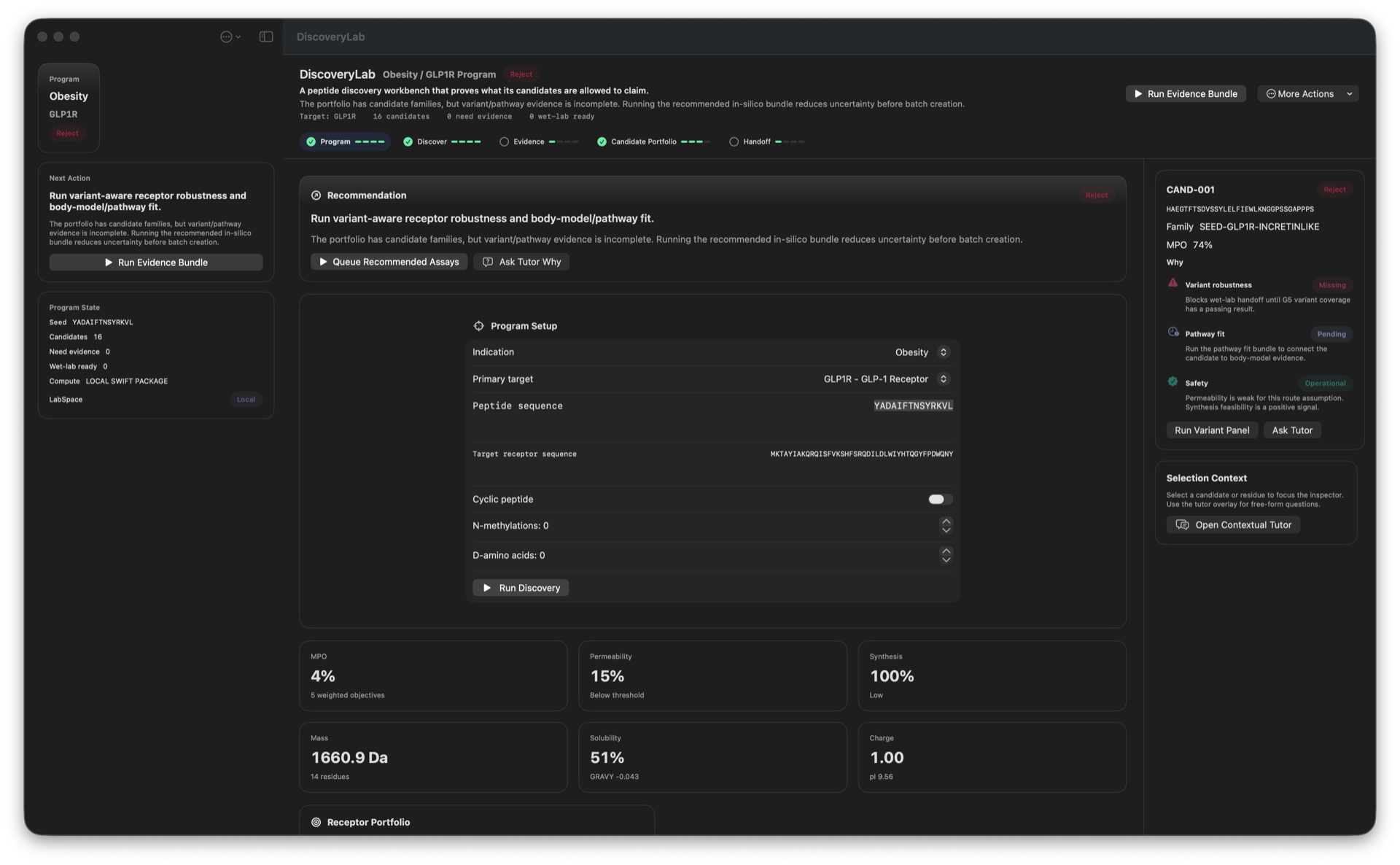
FIG · DiscoveryLab workspace pattern used by the epigenome vertical
DiscoveryLab application workspace showing peptide candidate hypotheses, scores, and evidence context
Three paths

One target — epigenomic fidelity — reached three different ways.

Aging-associated drift looks like a loss of regulatory precision: blurred enhancer/promoter/heterochromatin boundaries, repeat derepression, lost cell identity. No single modality reaches every lever. So DiscoveryLab runs all three, each with its own honest claim level, and lets the verification layer decide what combines.

Path 1 · direct
discovery

Peptides at the chromatin interface

Much of epigenetic control runs through short motifs and protein–protein interactions — histone tails, acetyl/methyl-lysine readers, repair-complex motifs. Peptides mimic, compete with, or redirect them with sequence-level specificity.

SIRT6 / heterochromatinH3K9me3 readersPARP1 repair couplingBRD4 · EZH2 · KDM1A

Calibrated reference modality. Signed mechanism attribution + machine-checked Lean receipts. This is where the live candidate ledger below lives.

Path 2 · enzymatic
rank-only

Small molecules over epigenetic enzymes

The established epigenetic-drug field targets writers, erasers, and readers directly — DNMTs, HDACs, EZH2, IDH, bromodomains. DiscoveryLab routes these through deterministic developability triage and a CNS translational layer.

HDAC / DNMT inhibitorsEZH2 · IDHBromodomain probesNAD⁺-axis modulators

ChemCheck v0: PAINS/Brenk + Lipinski/Veber filters, occupancy from supplied affinity + free-brain concentration. Rank-only until calibrated on measured outcomes.

Path 3 · indirection
rank-only

Microbiome-mediated routes to the epigenome

Don't dose the mark — move the metabolite that sets it. Steer the gut ecosystem so cross-feeding guilds raise host-facing signals that feed chromatin: butyrate (endogenous HDAC inhibition), methyl-donor flux (folate → SAM), and NAD⁺ precursors for sirtuins.

Butyrate → HDAC toneFolate → SAM methyl fluxNAD⁺ salvage → SIRT6FFAR2/3 · TGR5 signaling

Ecological dependency graph (helper → producer → metabolite → host receptor → cell state). Measurement-first plans only; no colonization, flux, or efficacy claim until calibrated.

The first rule holds across all three paths: do not optimize a single age clock and call it rejuvenation. A peptide, molecule, or metabolite shift that makes a methylation clock look younger while raising DNA damage, proliferation, or dedifferentiation is a failure — and the scorer is built to reject exactly that.

Cross-modal controller

Why combine paths: hold the fidelity variable where one lever can't.

The point of three paths is not breadth for its own sake — it is control. Take the SIRT6 / heterochromatin-fidelity axis. SIRT6 is an NAD⁺-dependent deacetylase, so a peptide that engages it under-controls if the NAD⁺ pool is depleted or competing acetyl-readers dominate. A combination closes those gaps from three directions — and the same verification machinery that already certifies inflammation and metabolism controllers (below) is what would certify it.

Proposed composition · SIRT6 / heterochromatin-fidelity axistarget · not yet certified
01 · Peptide
discovery
sirt6_activator_peptide

Restores SIRT6 deacetylase tone at heterochromatin; protects identity/chromatin/repeat endpoints.

02 · Microbiome
rank-only
NAD⁺-precursor + butyrate program

Raises the NAD⁺ pool SIRT6 depends on and lifts endogenous HDAC-inhibitory tone — without injecting either.

03 · Small molecule
rank-only
bromodomain reader probe

Trims the competing acetyl-reader pull so the deacetylase shift actually lands on the target loci.

Certified today · same machinery, different axesLean receipt

The combination-controller layer is not aspirational — it already certifies multi-modal controllers on inflammation and metabolism axes, each with a CI-recompiled Lean receipt. The epigenome composition above is the next axis fed to that same harness.

AxisK peak / troughRobust*Lean receipt
C5a / C5aR1
inflammation
0.112 / 0.10667%lyapunov_c5a_combination
IL-6 trans-signaling
inflammation
0.131 / 0.10979%lyapunov_il6_combination
Glucose lowering
metabolism · T2D triple
0.126 / 0.10874%lyapunov_glucose_combination

Band kMin–kMax = 0.10–0.16; every monotherapy gain is 0.072 (under-controls). *Robust = share of an ±15% potency × PK-trough grid (81 worlds) in which the combination stays a PK-robust controller. The SIRT6 / fidelity axis has no receipt yet — that is the work.

What the proof layer asks

Treated as a controller, the question is not "is each agent good?" but "does the combined intervention keep heterochromatin fidelity inside its target band across the real dosing cycle, where each single lever provably under-controls?" On the epigenome axis only the peptide carries a discovery claim today; the microbiome and small-molecule levers enter as rank-only hypotheses, so the SIRT6 combination is a verified-controller target, not a validated therapy — the certification it needs is exactly the kind already issued for the axes above.

Named kill-criterion

The combination is falsified if the factorial shows no super-additive gain in heterochromatin fidelity over the best single lever, or if any arm trips a hard safety gate — repeat derepression, DNA-damage burden, proliferation, or loss of lineage identity in the declared aged-fibroblast context.

Path 1 in depth · expert review packet

The peptide path, where the live evidence sits today.

Everything below is the most-developed of the three paths: the peptide program with signed attribution and a live candidate ledger. The strongest version of this is not a pitch that the platform has solved aging — it is a compact technical ask: can this workflow specify a credible epigenome-rescue program, reject unsafe shortcuts, and produce a narrow first wet-lab package worth testing?

What this is

A falsifiable workflow for epigenome-rescue hypotheses.

DiscoveryLab uses typed candidate cards, signed mechanism attribution, registered lab-loop evidence, and explicit rejection gates to decide which peptide hypotheses deserve wet-lab follow-up.

What this is not

No claim of rejuvenation, lifespan extension, or clinical efficacy.

The page is intentionally framed as research triage. It asks whether a cell-state rescue program can be specified, audited, challenged, and narrowed before expensive validation.

Current signal

A SIRT6 / heterochromatin-fidelity lead survived the first proof harness.

The lead candidate is promotable only within the declared aged-fibroblast context: positive rescue-loop output, protective signed attribution, no hard safety failure, and no clock-only shortcut.

Review ask

Challenge the biology module and the next assay package.

The useful critique is whether the target axes, safety rejects, and first wet-lab package are the right way to test epigenomic fidelity without overstating the result.

Suggested review question: does the SIRT6 / heterochromatin-fidelity program define the right cell-state rescue target, and are the proposed reject gates strong enough to avoid a misleading age-clock-only win?

How the platform can be used

Treat longevity as a decision workflow, not a generic age clock.

The epigenome track uses the same private DiscoveryLab loop as inflammation discovery: constrained generation, signed mechanism verification, registered lab-loop evidence, typed audit artifacts, and explicit stop conditions before any claim is allowed to move forward.

01

Define a cell-state rescue program.

Pick the cell type, aging failure mode, intervention class, and assay panel before the model generates candidates. The page uses aged fibroblast SIRT6 / heterochromatin fidelity as the first live program.

cell typefailure modeassay panel
02

Generate candidates with typed audit cards.

Each proposed peptide is forced into an EpigenomeRescueCard with target axis, expected chromatin mark changes, transcriptomic direction, required assays, and safety failure modes.

EpigenomeRescueCardtargetAxisrequiredAssays
03

Bind the mechanism to signed biology.

biology_epi_v1_signed gives candidate-endpoint attribution paths. The Lean receipt decides whether a candidate can claim identity, chromatin, repair, or repeat-silencing protection.

biology_epi_v1_signedlean/verifyattribution paths
04

Promote, revisit, or reject with R_epi.

The scorer rewards identity, chromatin, functional, and senescence rescue while penalizing pluripotency activation, DNA damage, oncogenic proliferation, broad chromatin disruption, and clock-only wins.

R_epipromoterejected_safety
Results so far

The current run found a SIRT6-centered lead and exposed the gaps.

These are research triage results from the signed-attribution proof harness and registered epigenome lab loop. They are not a claim of lifespan extension, healthspan extension, or clinical efficacy.

5
signed candidates scored

Program A candidates with attributed biology paths.

3
promote outcomes

SIRT6-axis rescue candidate, H3K9me3 mimic, and PARP1 chromatin redirector.

1
safety rejection

Broad DNA-repair inhibitor negative control failed the hard gates.

8
chromatin-interface gaps

BRD4 (reader) / KDM1A (eraser) / EZH2 (writer) specs held until signed attribution exists.

Current interpretation

The strongest signal is not that one score is high. It is that the lead candidate has signed protective attribution, a positive rescue-loop outcome, no hard safety failure, and no clock-only shortcut. The same run also preserved uncertainty: the BRD4 (reader), KDM1A (eraser), and EZH2 (writer) chromatin-interface specs are visible as revisit items instead of being promoted without formal biology.

Next assay decision

The next useful wet-lab package is narrow: SIRT6-axis engagement, heterochromatin fidelity, repeat derepression, DNA-damage burden, proliferation, and lineage-identity readouts in the declared aged-fibroblast context.

Candidate ledger

What we have found, what passed, and what the system refused.

The ledger separates promotable candidates from learning controls and intentional rejects. That distinction is the point: DiscoveryLab is useful only if it can say no before a bad longevity story becomes expensive.

01
sirt6_activator_peptide
SIRT6 / heterochromatin fidelity
promote
R_epi 3.018
Program A

Current lead. Positive rescue-loop outcome, protects identity/chromatin/repeat endpoints, and clears the hard safety gates.

R_epi signed-term breakdown
sum +3.018
identity
+0.890
chromatin
+0.890
function
+1.170
senescence
+0.237
pluripotency
-0.120
DNA damage
-0.030
broad disruption
-0.020
02
h3k9me3_mimic_peptide
histone-mark mimic
promote
R_epi 2.885
Program A

Strong backup candidate with signed protection of identity and chromatin-fidelity loss endpoints.

R_epi signed-term breakdown
sum +2.885
identity
+0.890
chromatin
+0.945
function
+1.170
senescence
+0.200
pluripotency
-0.120
DNA damage
-0.120
broad disruption
-0.080
03
parp1_chromatin_redirect_peptide
DNA repair / chromatin coupling
promote
R_epi 2.343
Program A

Useful repair-chromatin probe; narrower margin than the lead but still passes current gates.

R_epi signed-term breakdown
sum +2.342
identity
+0.670
chromatin
+0.435
function
+1.170
senescence
+0.237
pluripotency
-0.120
DNA damage
-0.030
broad disruption
-0.020
04
hp1_competitive_peptide
HP1A competition control
revisit
R_epi 0.560
Program A

Kept as a learning control because the lab loop is inconclusive and attribution is not protective enough.

R_epi signed-term breakdown
sum +0.560
identity
+0.050
chromatin
+0.050
function
+0.630
senescence
+0.150
pluripotency
-0.120
DNA damage
-0.120
broad disruption
-0.080
05
broad_dna_repair_inhibitor_peptide
intentional negative control
rejected_safety
R_epi -2.308
Program A

Rejected by design; proves the safety system refuses high-risk chromatin intervention paths.

R_epi signed-term breakdown
sum -2.308
identity
+0.050
chromatin
+0.125
function
+0.075
senescence
+0.113
pluripotency
-0.120
DNA damage
-1.530
broad disruption
-1.020

Chromatin-interface candidates such as EPI-BRD4-LEADOPT-001 (reader), EPI-EZH2-LEADOPT-001 (writer), and EPI-KDM1A-SEQONLY-001 (eraser) are already generated, but they stay in revisit status until the chromatin-interface TensorLang / Lean slice can attribute them to the declared epigenome-rescue endpoints.

Verified Epigenome Rescue · longevity vertical

The longevity angle is cell-state rescue, not age-reversal theater.

DiscoveryLab treats longevity as a falsifiable epigenomic-fidelity problem: discover peptides that preserve or restore cell identity, chromatin order, functional output, and senescence balance while formally rejecting unsafe reprogramming paths. This is not a claim of rejuvenation. It is a verified-rescue workflow with its own biology module (biology_epi_v1 plus biology_epi_v1_signed), typed audit card (EpigenomeRescueCard), lab loop, and R_epi scorer — the same private, mechanism-verified platform used for inflammation, applied to longevity biology without forking the architecture.

Longevity claim contract
Unit of claim

A declared cell type, aging failure mode, peptide intervention class, and assay panel — never generic age reversal.

Positive readouts

Identity restoration, chromatin fidelity, functional rescue, and senescence/SASP reduction.

Hard rejects

Pluripotency activation, DNA damage, oncogenic proliferation, broad chromatin disruption, and clock-only wins.

Benchmark path

EpiCheck v1: promote / revisit / rejected_safety / rejected_clock_only rows before any longevity claim.

Latest five DiscoveryLab commits reflected here
1738e14

Calibration in the improvement snapshot

The observation layer now reads calibration_report.json, lifts Brier/ECE/AUROC/AUPRC into SelfImprovementSnapshot, and maps regressions to claim_threshold or ranking_policy subsystem hints.

a867915

Epigenome discovery configuration

EPI-CHROMATIN-DISCOVERY-V1 adds BRD4/KDM1A/EZH2 targets, generator lanes, parent/negative/near-miss controls, experiment artifacts, and the first biology_epi_v1 TensorLang/Lean slice.

8f1b05e

EpigenomeRescueCard + module registry

biology_epi_v1 is registered in PeptiterMCPCatalog and each candidate can be represented as a typed EpigenomeRescueCard with target axis, evidence status, assays, and declared safety failure modes.

8178040

Signed twin, lab loop, and R_epi scorer

biology_epi_v1_signed carries attribution paths, the epi-sirt6-aged-fibroblasts lab loop runs through the same MCP catalog, runner output bridges into cards, and EpigenomeRescueScorer enforces safety and clock-only gates.

e3c011a

End-to-end epigenome demo

The epigenome proof harness drives the whole chain: default plan, card bridge, lean/verify, lab_loop/run, and three contrastive R_epi outcomes: promote, rejected_safety, and rejected_clock_only.

Program A · SIRT6 / heterochromatin fidelity
signed loop live

SIRT6 hub coupling DNA repair, heterochromatin, and repetitive-element silencing.

Six peptide candidates (SIRT6-axis rescue candidate — not yet a validated SIRT6 activator — HP1A competitor, H3K9me3 mimic, H3K9ac blocker, PARP1 chromatin redirector, plus an intentional broad-DNA-repair-inhibitor negative control) against eight targets. The unsigned biology_epi_v1 graph remains inspectable, while biology_epi_v1_signed adds per-path attribution so lean/verify can return a hash-bound, attributed receipt.

Program B · Chromatin-interface peptide mimics
scaffolded

Peptides that probe / redirect chromatin reader, writer, and eraser interfaces.

Chromatin control spans readers (BRD4 bromodomain, chromodomain, PHD, Tudor, YEATS recognize modified histone tails), erasers (KDM1A/LSD1 demethylase axis), and writers (EZH2/PRC2 methyltransferase axis) — distinct mechanisms, not all readers. Discovery target: candidates that selectively modulate pathological interface binding in aged or inflamed cells without global disruption. Follow-up to Program A — same EpigenomeRescueCard schema, biology_epi_v2 will encode the interface graph.

Program C · Senescence-state peptides
scaffolded

FOXO4-DRI-class peptides that selectively remove cells with irreversible epigenomic drift.

For cells too epigenetically disordered to repair, removal is the right move. Two tracks: peptides that restore repairable cells (Programs A/B) and senolytic/senomorphic peptides for the irreversible. EpigenomeRescueCard.SafetyFailureMode.lossOfLineageIdentity captures the boundary — anything that perturbs healthy non-senescent cells fails the gate.

Current proof harness · candidate agent run

The current promote candidate: sirt6_activator_peptide

We did not hand-pick the result from a single score. The current rerun searched 5 signed-attribution candidates and kept all 8 runner-generated specs visible as no-attribution gaps. The agent used the same platform surfaces an operator would use: lean/verify for signed biology attribution, per-candidate lab_loop/run calls for the aged-fibroblast rescue loop, and EpigenomeRescueScorer for the identity/chromatin/function score with hard safety penalties. The visible score split below is the actual Score.Breakdown: four rescue terms plus three safety penalties that sum to R_epi.

selected
3.018
R_epi
sirt6_activator_peptide

Positive lab-loop outcome, no hard safety gates tripped, no clock-only failure, signed protection against identity_loss, chromatin_fidelity_loss, and repeat_derepression, with aggregate run fingerprint 611fa1bee9927dd1.

R_epi signed-term breakdown
sum +3.018

These are the seven existing Score.Breakdown terms: four rescue contributions and three safety penalties. Clock-only remains a gate, not a displayed sub-score.

identity
+0.890
chromatin
+0.890
function
+1.170
senescence
+0.237
pluripotency
-0.120
DNA damage
-0.030
broad disruption
-0.020
How the candidates were produced
1 · Generate the search space

EPI-CHROMATIN-DISCOVERY-V1 defines eight BRD4 (reader) / KDM1A (eraser) / EZH2 (writer) runner specs plus controls. The current signed epigenome receipt is still Program A-focused, so those runner specs are reported as no_attribution_available until the chromatin-interface TensorLang slice catches up.

2 · Bind candidates to formal biology

biology_epi_v1_signed turns each candidate-endpoint relation into signed attribution paths. lean/verify checks the TensorLang ↔ Lean hash binding and returns the path-level receipt.

3 · Run the rescue loop

The epigenome candidate agent now runs the registered epi-sirt6-aged-fibroblasts lab loop once per signed-attribution candidate, producing candidate-scoped traces and fingerprints instead of one shared trace.

4 · Score with rescue gates

The agent converts attribution plus lab-loop output into EpigenomeRescueScorer.Outcome. Functional rescue now comes only from the lab outcome, keeping the clock-only rejection gate live.

Ranked signed-attribution candidate outcomes
01
sirt6_activator_peptide
positive lab-loop outcome
promote
R_epi 3.018

Selected by the epigenome candidate agent. It protects identity_loss, chromatin_fidelity_loss, and repeat_derepression, clears the hard safety endpoints, avoids the clock-only failure mode, and returns a candidate-scoped positive lab-loop readout.

R_epi signed-term breakdown
sum +3.018
identity
+0.890
chromatin
+0.890
function
+1.170
senescence
+0.237
pluripotency
-0.120
DNA damage
-0.030
broad disruption
-0.020
02
h3k9me3_mimic_peptide
positive lab-loop outcome
promote
R_epi 2.885

A strong backup. The signed attribution protects the identity and chromatin loss endpoints and strengthens repeat-derepression protection without triggering forbidden safety paths.

R_epi signed-term breakdown
sum +2.885
identity
+0.890
chromatin
+0.945
function
+1.170
senescence
+0.200
pluripotency
-0.120
DNA damage
-0.120
broad disruption
-0.080
03
parp1_chromatin_redirect_peptide
positive lab-loop outcome
promote
R_epi 2.343

Promotes, but with a narrower margin. It looks useful as a repair-chromatin coupling probe, with weaker chromatin/repeat attribution than the leading rescue candidate.

R_epi signed-term breakdown
sum +2.342
identity
+0.670
chromatin
+0.435
function
+1.170
senescence
+0.237
pluripotency
-0.120
DNA damage
-0.030
broad disruption
-0.020
04
hp1_competitive_peptide
inconclusive lab-loop outcome
revisit
R_epi 0.560

Kept as a learning control. The lab-loop readout is inconclusive, and signed attribution marks identity and chromatin loss as net activator paths rather than protection.

R_epi signed-term breakdown
sum +0.560
identity
+0.050
chromatin
+0.050
function
+0.630
senescence
+0.150
pluripotency
-0.120
DNA damage
-0.120
broad disruption
-0.080
05
broad_dna_repair_inhibitor_peptide
negative lab-loop outcome
rejected_safety
R_epi -2.308

Intentional negative contrast. It activates forbidden endpoints and proves the safety gate rejects a high-risk chromatin intervention.

R_epi signed-term breakdown
sum -2.308
identity
+0.050
chromatin
+0.125
function
+0.075
senescence
+0.113
pluripotency
-0.120
DNA damage
-1.530
broad disruption
-1.020
Runner-generated specs awaiting signed attribution
8
no_attribution_available

These BRD4/KDM1A/EZH2 runner candidates now appear in the agent report instead of disappearing. They receive revisit dispositions with lab=not_tested because the current signed receipt does not yet bind them to epigenome-rescue endpoints. The next scientific task is to extend the TensorLang/Lean biology slice for the chromatin-interface track (reader, writer, and eraser axes) before treating them as promotable rescue candidates.

EPI-BRD4-LEADOPT-001
revisit · R_epi 0.755
EPI-BRD4-MACRO-001
revisit · R_epi 0.755
EPI-BRD4-NEARMISS-001
revisit · R_epi 0.755
EPI-BRD4-PARENT-001
revisit · R_epi 0.755
EPI-BRD4-SCRAMBLE-NEG-001
revisit · R_epi 0.755
EPI-BRD4-SEQONLY-001
revisit · R_epi 0.755
EPI-EZH2-LEADOPT-001
revisit · R_epi 0.755
EPI-KDM1A-SEQONLY-001
revisit · R_epi 0.755
Structure viewers · WebGL folded traces

Candidate geometry is treated as an artifact, not a browser-side prediction.

The current viewers are rendered from precomputed coarse-grained PDB traces emitted by the local folding path (PEPFOLDMetal refine-full). The same viewer accepts AlphaFold, Boltz, OpenFold, or MD-derived coordinates once those artifacts are produced offline and attached to the candidate record.

For this track, AlphaFold DB is the right source for target/domain context such as SIRT6, HP1A, PARP1, KU70, or 53BP1 when UniProt-backed structures are available. Short synthetic peptide candidates usually need explicit prediction runs rather than a precomputed database lookup, so the page records the geometry source beside each sequence instead of implying validated structural truth.

input
candidate sequence + target/domain context
artifact
PDB/mmCIF trace from AlphaFold/Boltz/PEPFOLD/MD
viewer
Three.js WebGL backbone + residue beads
claim boundary
triage geometry; not wet-lab structure
sirt6_activator_peptide
Program A target-sequence binder seed
h3k9me3_mimic_peptide
Program B macrocycle / reader-domain mimic seed
parp1_chromatin_redirect_peptide
Program A DNA-repair chromatin-coupling seed
hp1_competitive_peptide
near-miss reader-domain calibration seed
broad_dna_repair_inhibitor_peptide
negative-control repair-inhibitor seed
Hard safety classes · forbidden endpoints

What the verifier refuses before a longevity claim exists.

The first rule — do not chase age reversal directly — is encoded as forbidden endpoints in biology_epi_v1_signed. lean/verify returns a hash-bound receipt with attribution paths, so each safety or efficacy result can be traced back to the signed mechanism slice; any reachable counterexample is surfaced explicitly instead of silently passing through.

pluripotency_activation

OCT4 / SOX2 / NANOG re-expression — partial reprogramming risk

dna_damage_burden_high

γH2AX foci / p53 pathway activation — repair damage worse than the cure

oncogenic_proliferation

EdU / Ki67 / cell-cycle re-entry — turning aged into transformed

broad_chromatin_disruption

global ATAC accessibility distribution shift — chromatin chaos

EpigenomeRescueCard · the typed audit artifact

Per-candidate record matching the rescue-card schema.

Every peptide proposed under this vertical produces an EpigenomeRescueCard. The card carries the program tag, the target axis, the predicted chromatin mark and transcriptomic changes, the safety failure modes the candidate must avoid, and the assays that gate against each failure mode. The card surfaces its own incompleteness via ungatedSafetyFailureModes — a card that names a risk without proposing how to detect it cannot pass review. Runner output now bridges into this card automatically, so the generated epigenome candidates enter the audit surface before a lab loop or promotion decision.

program

Program tag: A (SIRT6), B (chromatin interfaces), C (senescence)

peptide

Identifier, sequence, modifications, delivery strategy

targetAxis

reader_domain · chromatin_regulator_ppi · sirt6_repair_chromatin · metabolic_to_epigenome · senescence_ppi · nuclear_delivery

cellType

aged dermal fibroblast · senescent endothelial · aged muscle satellite · etc.

agingFailureMode

Specific epigenomic failure the candidate claims to rescue

expectedChromatinMarkChange

Mark + locus + direction + magnitude. H3K9me3, H3K27ac, H4K16ac, …

expectedTranscriptomicChange

Gene set + direction + required panel (RNA-seq, ATAC, scRNA)

safetyFailureModes

Non-negotiable cell-state safety classes the card must declare upfront

requiredAssays

Every safety failure mode must be paired with an assay that gates against it

evidenceStatus

hypothesis_only → in_silico_verified → wet_lab_pending → wet_lab_confirmed/refuted

leanBiologyModule

biology_epi_v1_signed by default, so verification uses attributed paths

labLoopName

epi-sirt6-aged-fibroblasts, the registered closed loop for Program A

R_epi

Identity + chromatin + function + senescence rescue minus pluripotency, DNA-damage, and broad-disruption penalties

Why this matters architecturally. The Epigenome Rescue track does not bring its own MCP prefix, its own dispatcher, or its own lifecycle. It is a new biology module registered in the same PeptiterMCPCatalog.defaultLeanModules, a new typed Codable in the same Swift package, a registered epi-sirt6-aged-fibroblasts lab loop, and a new program tag the same improvement/* proposal lifecycle and improvement/snapshot ledger already handle. The proof-harness CLI runs plan generation, card bridging, Lean verification, lab-loop execution, and three contrastive R_epi verdicts through one path.